

Advanced Lesson 15 of 18 · 7 min read Long term
Mapping the AI trade, layer by layer
Chips, foundry, memory, networking, power and cloud. Where each layer earns, and where it breaks.
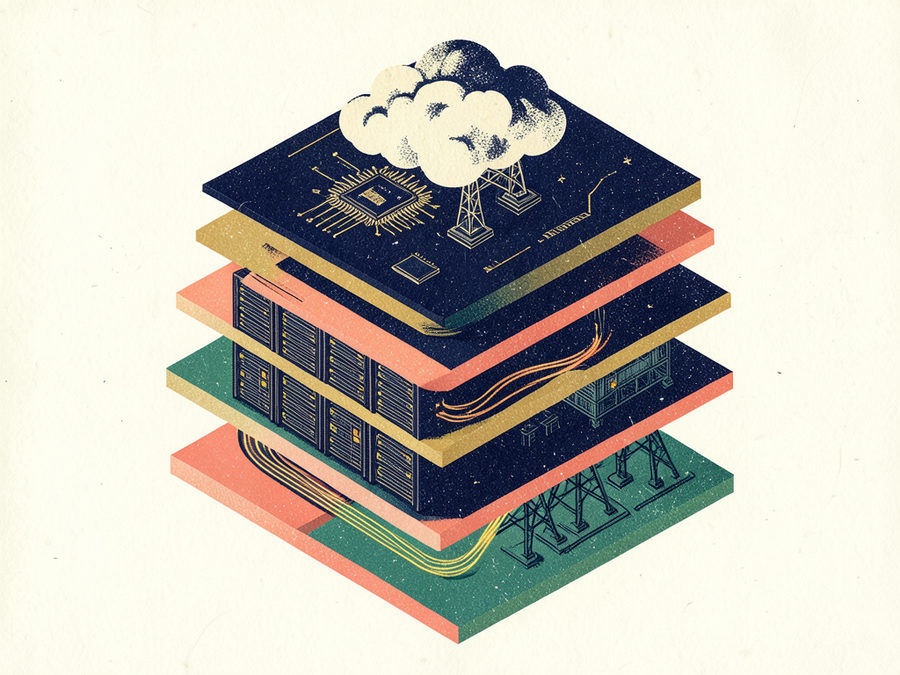
- The AI build-out is a supply chain: chips, foundry, memory, networking, power, cloud and software. Each layer earns at a different time and breaks for a different reason.
- One number moves the whole chain: how much the giant cloud companies plan to spend.
- If you hold several AI names, spread them across layers, and size each one so a 25 to 40% drop does not force a sale.
"AI stocks" is too broad to be useful. The build-out is a supply chain, and each layer earns money at a different time and breaks for a different reason. Mapping the layers tells you what a headline actually means for a stock.
| Layer | Examples | How it earns | What breaks it |
|---|---|---|---|
| Accelerators | NVDA, AMD, AVGO | GPUs and custom chips for training and inference | Hyperscaler spending slows, custom chips take share |
| Foundry | TSM | Manufactures nearly every leading-edge AI chip | Geopolitics, capacity overbuild |
| Memory | MU | High-bandwidth memory stacked beside each GPU | Memory is cyclical; prices fall when supply catches up |
| Networking | ANET, AVGO | Switches and chips that connect thousands of GPUs | Architecture shifts, customer concentration |
| Power and cooling | VRT | Power delivery and liquid cooling for dense racks | Project delays, grid constraints |
| Cloud and platforms | MSFT, GOOGL, AMZN, META, ORCL | Rent compute and sell AI inside products | Spending grows faster than AI revenue |
| Software | PLTR | Applications built on top of the models | High valuation, slower enterprise adoption |
GPU: the graphics processor that runs most AI work. Training builds a model; inference runs it to answer requests. Foundry: a company that manufactures chips other companies design. Leading-edge: the newest, smallest chip-making process. Customer concentration: a few buyers make up most of the sales.
The one number that moves the whole chain
Hyperscaler capital spending. Hyperscalers are the giant cloud companies. Capital spending, or capex, is what they spend on data centers, chips and equipment. When they raise their capex guidance, the forecast they give investors, suppliers up the chain tend to rally. When they trim it, the suppliers often fall hardest, because their revenue is someone else's budget. Every earnings season, read the capex line from Microsoft, Alphabet, Amazon and Meta before anything else.
Members only
The rest of this lesson is for members.
Open it free with the 7-day trial: every lesson, plus today's picks with entry zones and stops. No card.
Log inEducation only. Not personal investment advice. Examples use round numbers for clarity; check current prices, fees and rules before acting.